Orbit:
Apolloq = 0.98 AU
a = 1.23 AU
i = 1 deg
Abs. magnitude:
H = 25.5Rotation period, amplitude:
P = 10.70 min, ampl. 0.3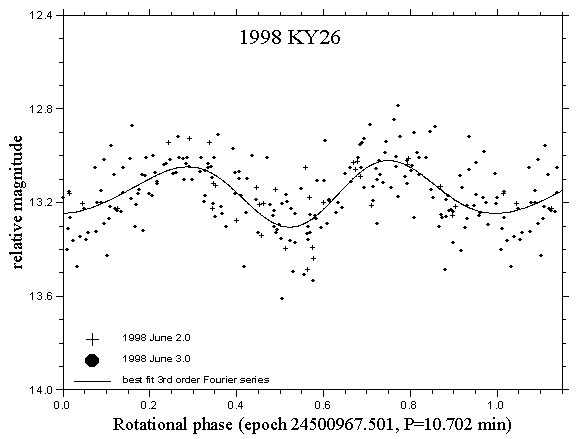
Orbit:Apolloq = 0.98 AU a = 1.23 AU i = 1 deg Abs. magnitude:H = 25.5Rotation period, amplitude:P = 10.70 min, ampl. 0.3 |
|
The lightcurve shows two maximum/minimum pairs per period, thus it looks like
a normal asteroidal rotational lightcurve. Our interpretation of the
period as being the rotation period of the object is in agreement with the
radar results by Ostro et al. (IAUC 6935). The period is by about one order
less than the shortest rotational periods of asteroids observed up to now.
The quite fast rotation indicates that the object is a monolithic body.
A body composed of
pieces held together by self-gravitation only (the so-called
'rubble pile' structure; cf. Harris 1996, Lunar Planet. Sci. 27,
493) would require an unrealistic bulk density of more than 340
g/cm^3.
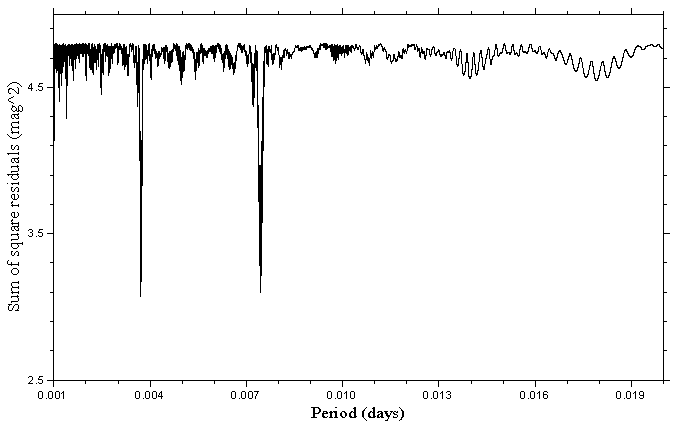
The following figure shows a dependence of the sum of square residuals of the best fit 2nd order Fourier series to the lightcurve data on the period. The above mentined period as well as a half of it are detected. The longer period is probably the real period of the asteroid, as there is marginally detected also the 3rd harmonic in the composite lightcurve for the longer period.
|
Back to the Ondrejov NEO program page.