The evolution of velocity dispersion in Sco-Cen correlates with star formation bursts
Figure by
Großschedl et al. (2025)
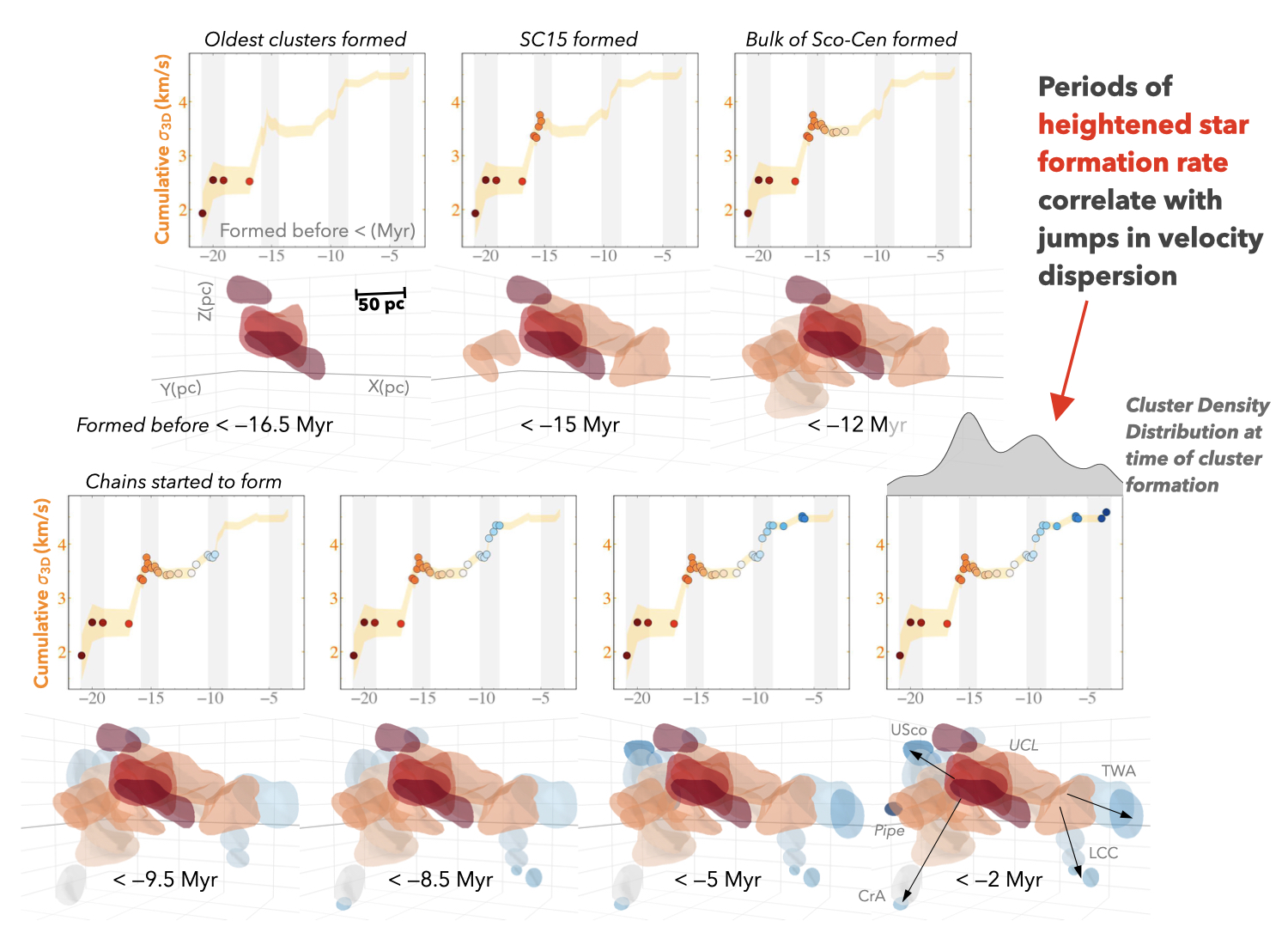
Using data from the Gaia mission along with supplementary stellar radial velocities, we identified a surprising sequence of abrupt jumps and intervening plateaus in the evolution of velocity dispersion (Cumulative 𝜎3D), correlating with star formation bursts.
We find that younger star clusters within the association exhibit higher velocities compared to older ones.
This result suggests a structured and sequential star formation process rather than a random one.
This phased evolution strongly suggests that stellar feedback is the primary driver of Sco-Cen’s star formation history, expansion, and eventual dispersal.
Sco-Cen cluster chains
3D Interactive Figure from
Miret-Roig et al. (2025)
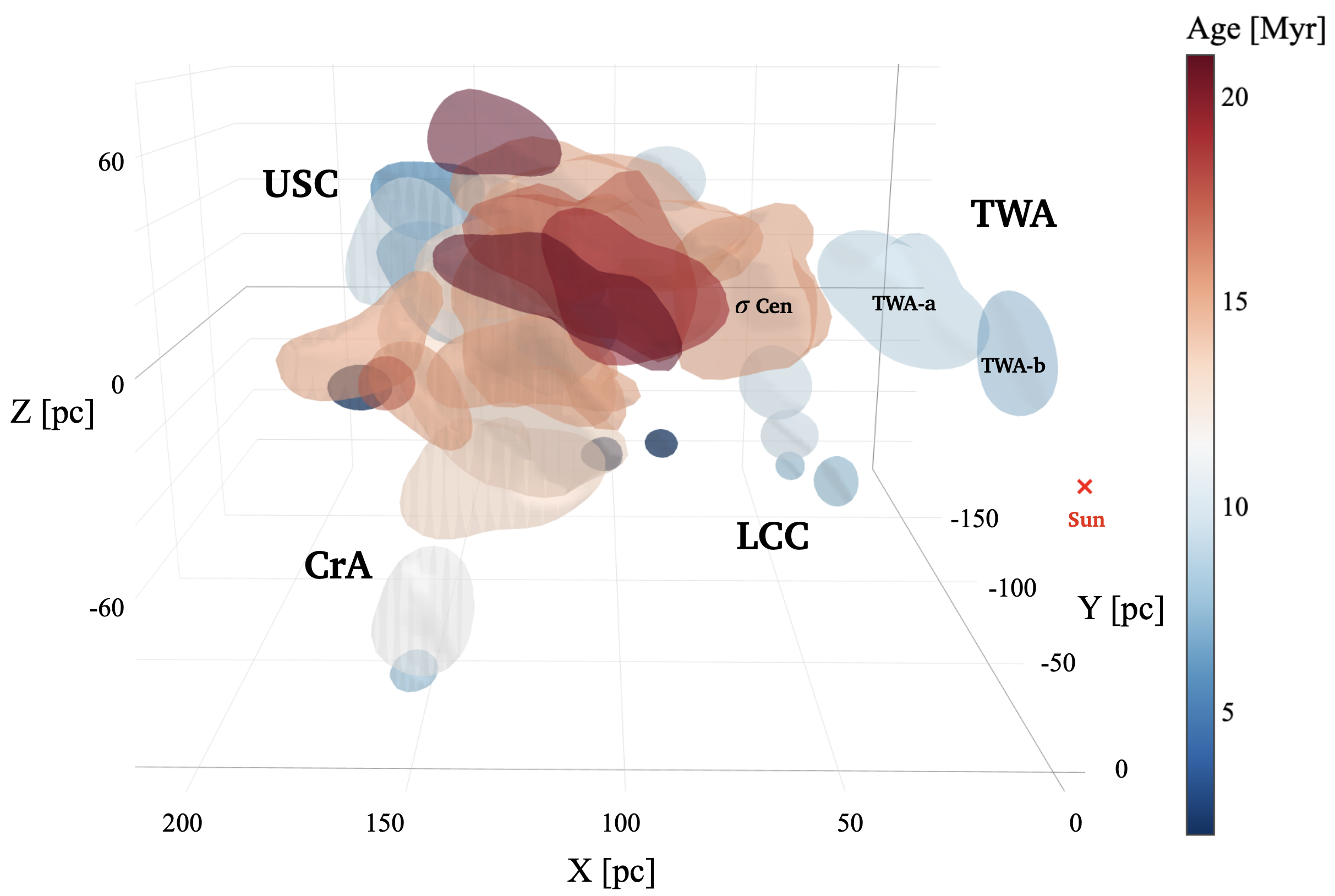
Sco-Cen harbors at least four chains of clusters.
Clusters younger than about 10 Myr are arranged with well defined age, mass, positions, and velocity gradients, extending from inside-out.
This suggests a history of sequentially propagated star formation, likely influenced by feedback from massive stars that formed early in the region.
See details in
Ratzenböck et al. (2023b),
Posch et al. (2023,
2025), and
Miret-Roig et al. (2025).
The Sun's passage through the Radcliffe Wave
3D Interactive Figure from
Maconi et al. (2025)
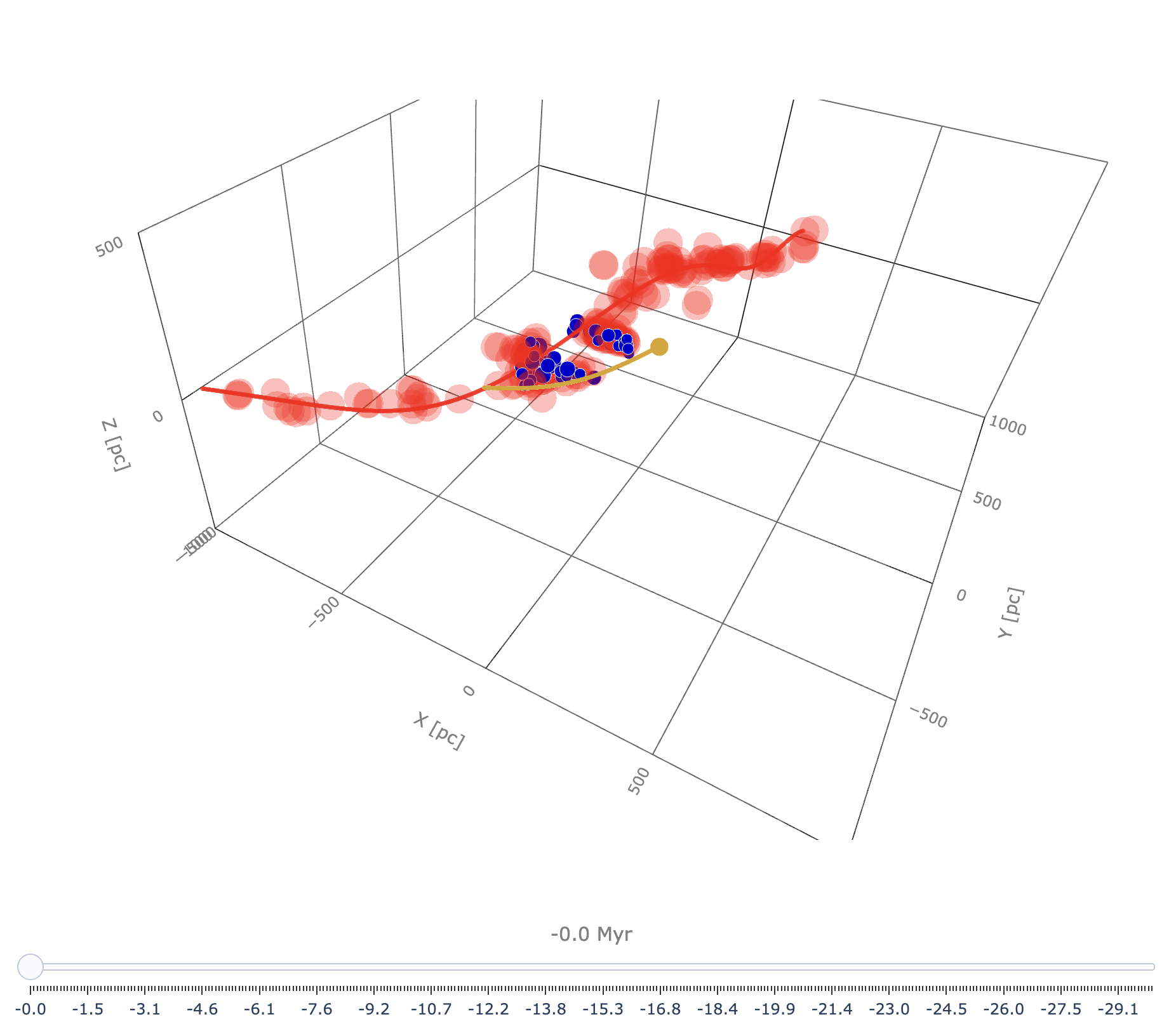
We find that the Sun passed the Radcliffe Wave within several 10s of parsec, only about 14-15 Myr ago, mainly passing clouds that belong to the Orion star-forming complex.
At that time, many of the young stellar populations have been still in the molecular cloud phase.
Hence, the Sun likely passes through a relatively dense region of the interstellar medium (ISM).
Therefore, it is possible that dust from these clouds could have reached our Solar system, and hence the Earth.
About 15 Myr ago, the Earth was in an age called the Middle Miocene cooling period,
which might have been partially influenced by increased dust loading.
Future work is needed to better understand if these two events are truly correlated.
Most nearby young star clusters formed in only three cluster families
3D Interactive Figures from
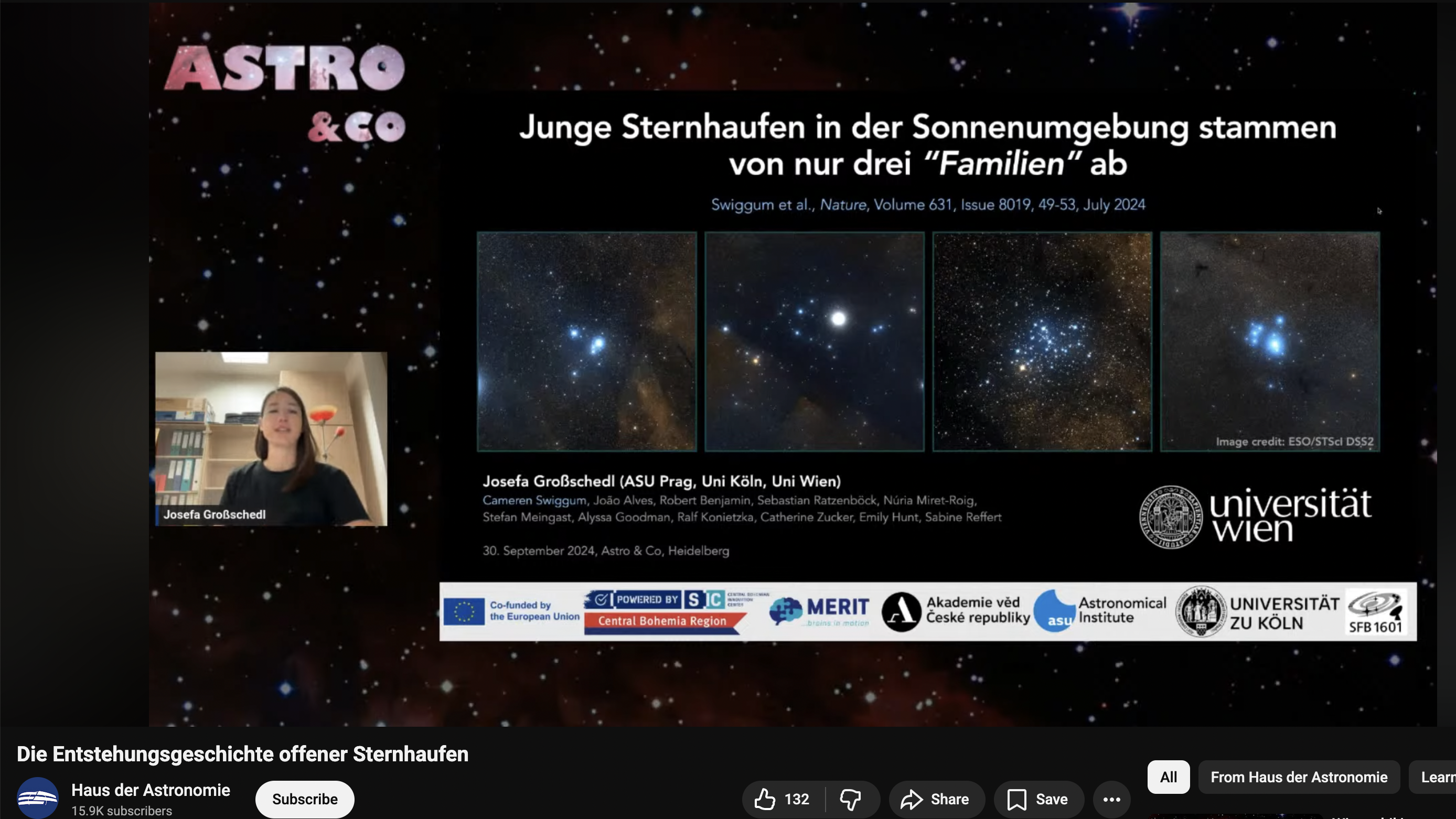
Swiggum et al. (2024, Nature)
We find that most nearby young star clusters formed in three massive complexes in the past (starting about 50 Myr ago), which we named families of clusters.
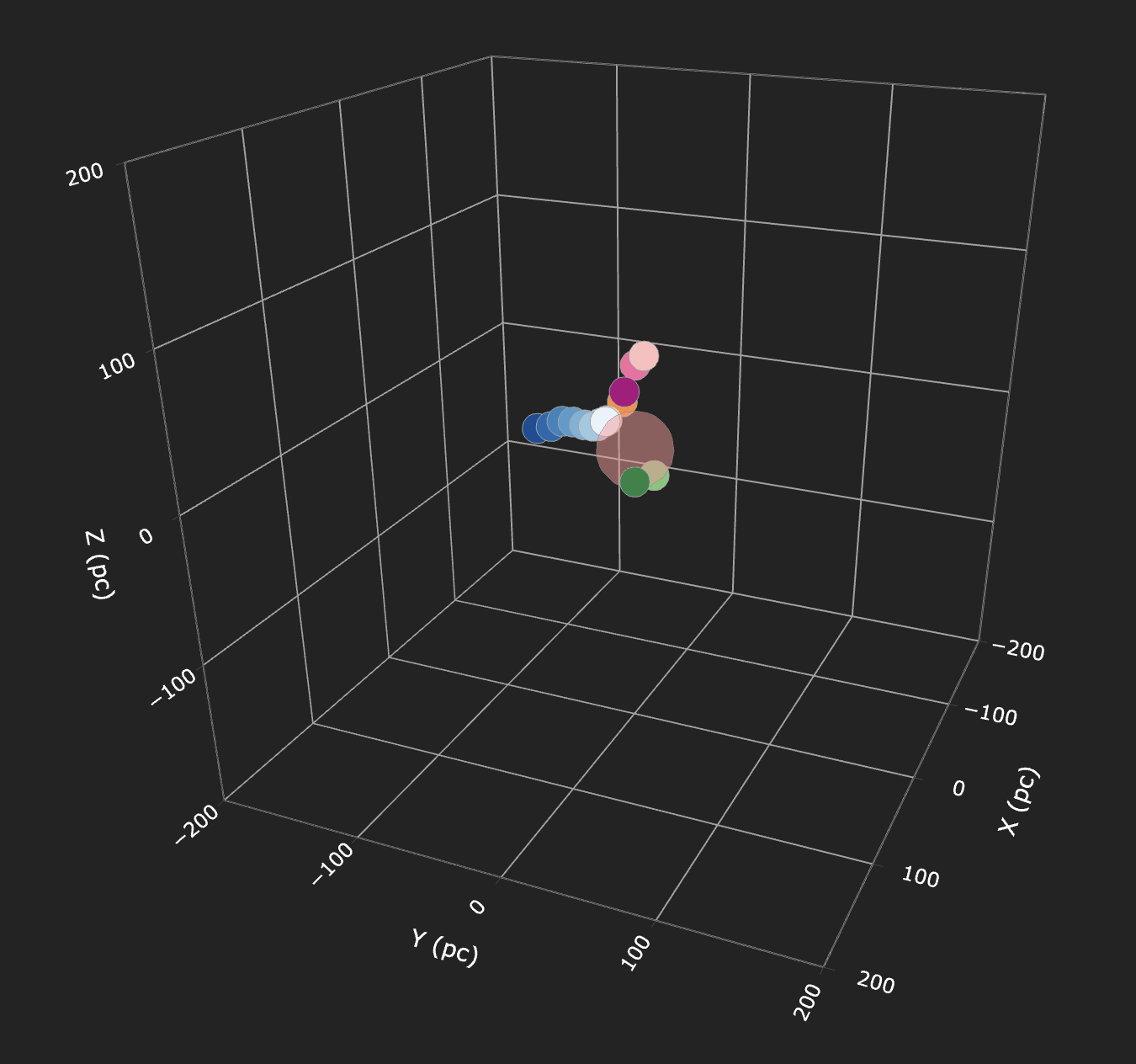
In the interactive figure, each data point represents the location of a young open cluster.
A timeslider allows to trace the orbits of the clusters back in time, showing their past locations (symbols get small and disappear when the time of cluster formation is reached).
The three colors highlight the membership of each cluster to one of the three families of clusters.
See also the cluster positions in relation to the 3D gas distribution in
Interactive Figure 2.

Sco-Cen Spatial-Temporal patterns
3D Interactive Figure from
Ratzenböck, Großschedl et al. (2023b)
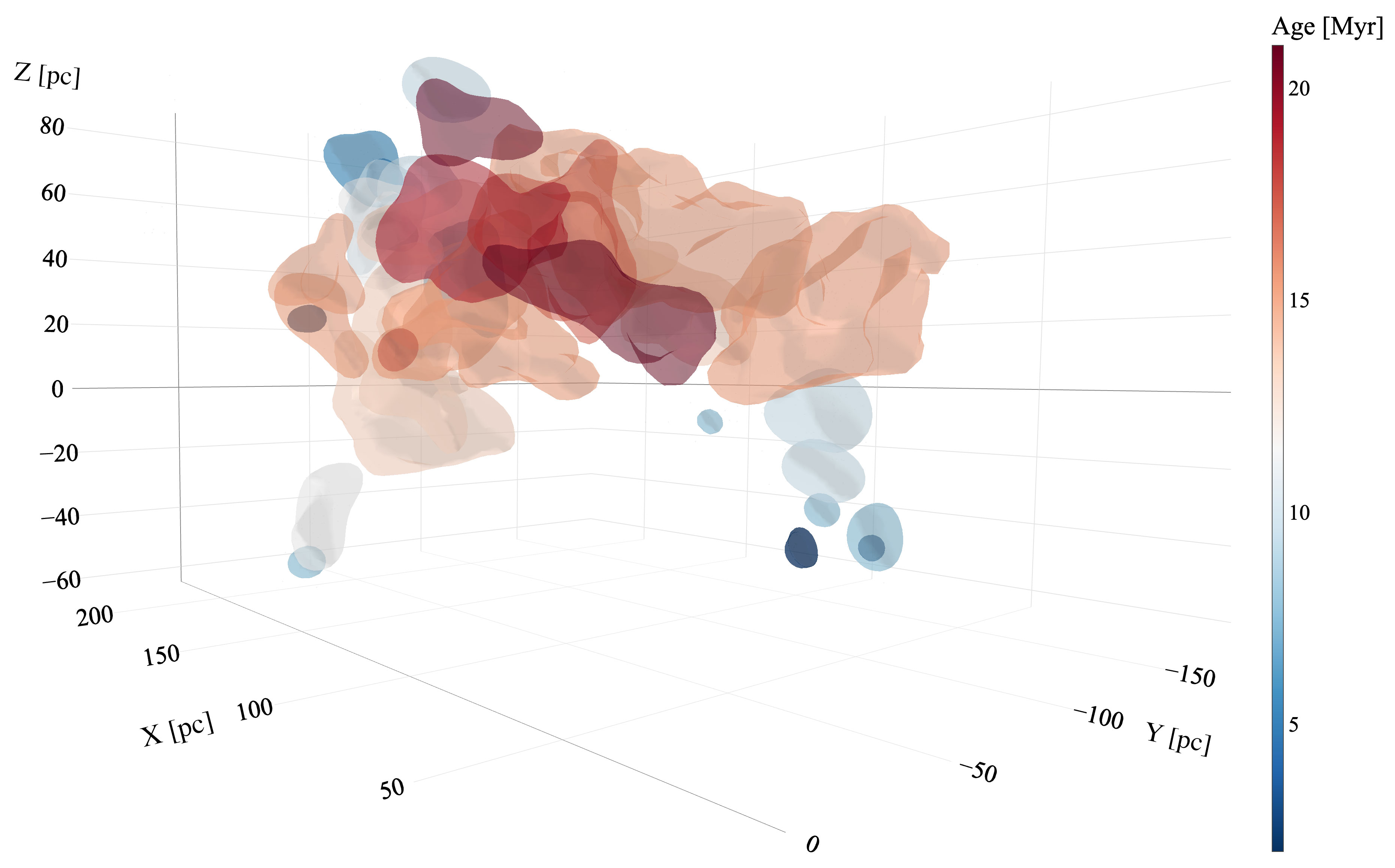
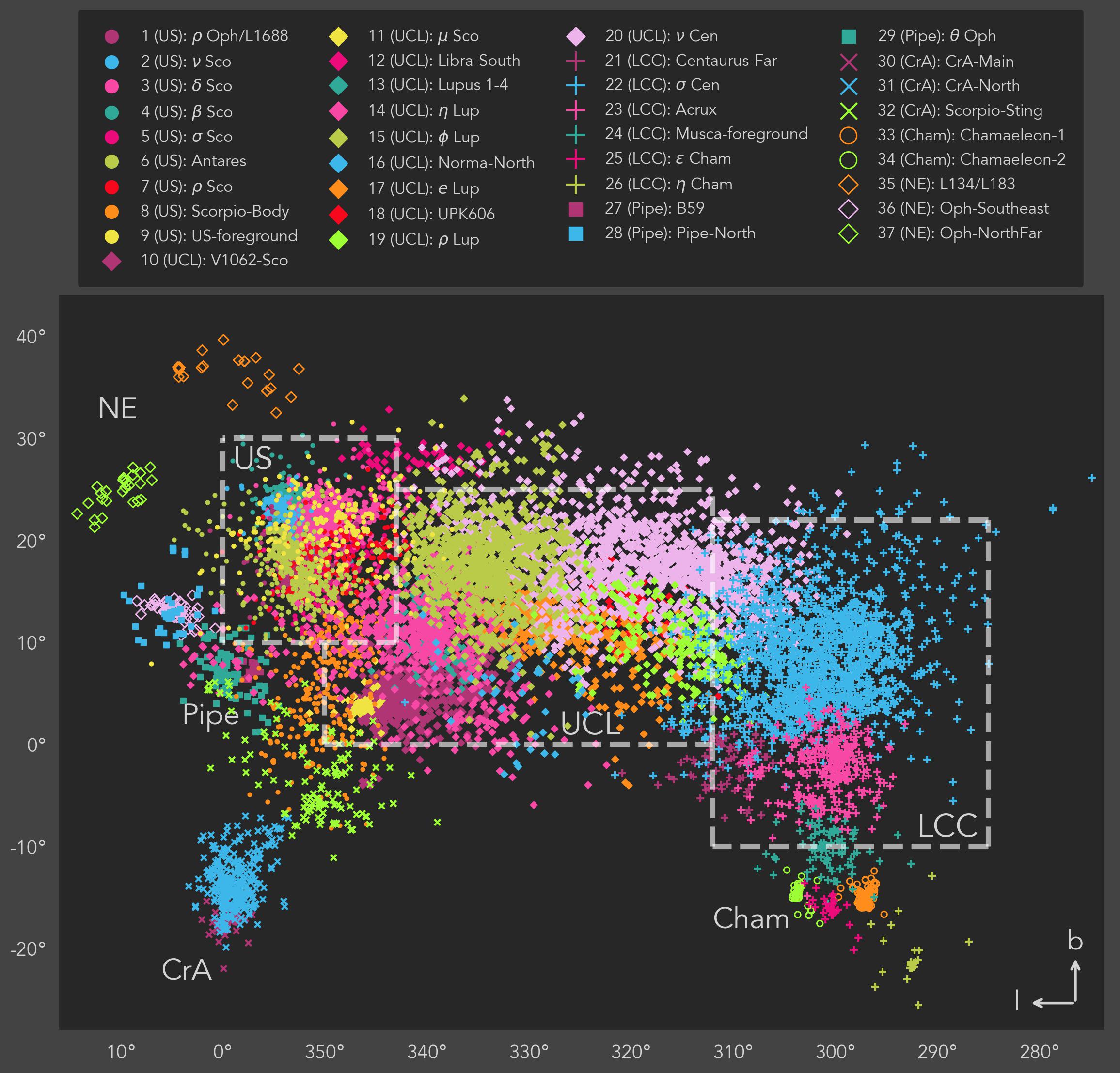
We have determined the ages of the 34 stellar clusters that belong to the Sco-Cen OB association, using the cluster catalog from
Ratzenböck, Großschedl et al. (2023a).
Our analysis reveals a clear spatial-temporal pattern, where older clusters are in the center of the association and younger clusters are at the outskirts.
This indicates a sequential star-formation history, where star formation propagated from the inside-out, likely influenced by feedback from massive stars that formed first in the older clusters in the central regions.
Orion Big-Blast Event
3D Interactive Figure from
Großschedl et al. (2021)
The Figure shows the 3D space motions of molecular clouds in the Orion star-forming complex, from -7 to +7 Million years (Myr).
The orbital tracebacks of molecular clouds (or cloud parts) in Orion reveals that they have been closer in space about 6 Myr ago.
The clouds are now expanding away from each other on the 100-pc scale.
This indicates external influences, like, feedback from massive stars originating from the older generations of stellar clusters in Orion (supernovae, stellar winds, ionizing radiation).
The clouds' most compact configuration about 6 Myr ago likely marks the onset of the expansion, which we name the Orion Big-Blast event (Orion-BB).
This is the first time that we were able to trace 3D space motions of molecular clouds, determined with the help of Gaia DR2 data.