
RESIDUAL ERRORS IN ALTIMETRY DATA
DETECTED BY COMBINATIONS OF
SINGLE- AND DUAL-SATELLITE CROSSOVERS
version "comb_996.tex ", 29th July '99
Jaroslav Klokočník (2), Carl A. Wagner (1), Jan Kostelecký (3),
(1) NOAA, 1305 East-West Highway, Silver Spring, MD-20910, USA.
(2) Astronom. Inst. Czech Acad. Sci., CZ-251 65 Ondřejov Observatory
(3) Faculty of Civil Eng., CTU Prague, CZ-160 00 Prague 6, Thákurova 7 and Research Institute of Geodesy Topography and Cartography,
CZ - 250 66 Zdiby.
ABSTRACT
The Single- and Dual-Satellite Crossover (SSC and DSC) residuals between and among Geosat, T/P, and ERS 1 or 2 have been used for various purposes, applied in geodesy for gravity field accuracy assessments and determination as well as in oceanography. Here we present the theory and give various examples of certain combinations of SSC and DSC that test for residual altimetry data errors, mostly of non-gravitational origin, of the order of a few centimeters. There are 4 types of the basic DSCs and 12 independent combinations of them in pairs which we have found useful in our work. We define them in terms of the "mean" and "variable" components of a satellite's geopotential orbit-error from Rosborough's 1st order analytical theory. The remaining small errors, after all altimeter data corrections are applied and the relative offset of coordinate frames between altimetry missions removed, are statistically evaluated by means of the Student distribution. The remaining signal of 'non-gravitational' origin can in some cases be attributed to the main ocean currents which were not accounted for among the media or sea surface corrections. In future, they may be resolved by a long-term Global Circulation Model. We describe our experience with two current one's (Stammer et al., 1996 and Carton, 1996) neither of which are found either to cover our most critical missions (Geosat & TOPEX/Poseidon) or to have the accuracy and resolution necessary to account for the strongest anomalies found across them. In other cases, the residual signal is due to errors in tides, altimeter delay corrections or El Niño. (We present various examples of these as well.) Our tests of the combinations of the JGM 3-based DSC residuals show that overall the long-term data now available are well suited for a gravity field inversion refining JGM 3 for low and resonant order geopotential harmonics whose signatures are clearly seen in the basic DSC and SSC sets.Key words. Satellite altimetry, Single- and Dual- crossovers, Student-t statistics.
1. THEORETICAL PART
1.1. Introduction
"If the change of global mean sea level is to be accurately
measured by satellite altimeter, the consistency and accuracy
of all aspects of the measurement process, including the complex
of media corrections and orbit models, will have to be assured"
(Wagner and Cheney, 1992). There are not only "traditional"
media corrections, sea state bias, inverse barometer correction,
the 1 cpr empirical orbit correction, etc., but also a new complication,
unexpected before: there appears to be relative coordinate system
offset in our cross-mission (DSC) altimetry data,
though how this occurs is not fully understood
(Wagner et al, 1997b).
In our previous
papers (Wagner et al, 1997a,b), we have developed and numericaly
tested algorithms for the identification and removal of these offsets
and applied them to the most egregious case, namely the DSCs between
the less accurate Geosat and the more accurate TOPEX/Poseidon
(T/P) missions.
To interconnect multiple altimetry missions (and assess as long an
oceanographic series of data as possible), this correction must
be removed before oceanographic application can take place.
Numerically, extraction of the offset may pose a problem however, as
the forbidden harmonics (representing the relative offset)
inevitably correlate with the higher degree first order
geopotential harmonic coefficients
(e.g., Bosch et al, 1998)
that are also uncertain in the orbit
model used to generate the altimeter heights.
In this paper, we investigate residual altimetry errors
by using certain combinations of the dual-satellite crossovers
(DSC), offset-free when necessary.
We make use of long-term averaged
(over 1-3 years) crossover data. We assume that the reader is
familiar with the definitions of the single-satellite crossovers
SSCs and the DSCs (Shum et al, 1990;
Klokocnik et al, 1993) and with the
Rosborough-Engelis analytical theory (Rosborough 1986,
Engelis 1987, Rosborough and Tapley, 1987).
1.2. Twelve Combinations of the DSCs
Definitions
Rosborough (1986) showed explicitly that and how
the radial orbit component  is decomposed
into two parts,
is decomposed
into two parts,  , geographically correlated
part (does not depend on the sense of the orbit track),
sometimes called the 'mean', and
, geographically correlated
part (does not depend on the sense of the orbit track),
sometimes called the 'mean', and  ,
called the 'variable' or anticorrelated part (of the same
magnitude but opposite sign for the ascending and
descending orbit segments).
The Single Satellite Crossovers (SSCs) in terms
of Rosborough's theory (Rosborough, 1986) are:
,
called the 'variable' or anticorrelated part (of the same
magnitude but opposite sign for the ascending and
descending orbit segments).
The Single Satellite Crossovers (SSCs) in terms
of Rosborough's theory (Rosborough, 1986) are:

where A, D denote the Ascending and
Descending tracks, respectively, and
is the variable part.
The Dual-Satellite Crossovers DSCs (AD, DA, AA and DD) are
(Klokocnik et al, 1993):




where the lower indices "1"/ "2" belong to the first/second orbit
of the satellite's pair
(e.g.  ).
Usually (but not necessarily), the first
satellite in the pair is 'low' flying, the second is 'higher'
flying (e.g., Geosat & Topex).
).
Usually (but not necessarily), the first
satellite in the pair is 'low' flying, the second is 'higher'
flying (e.g., Geosat & Topex).
In the following text, we use more concise
notation, e.g. instead  , we write "AD";
the first/second capital for the respective track of the
first/second satellite of the given pair.
There are just 12 independent combinations of the DSCs,
taken in pairs (Klokocnik and Wagner, 1999):
, we write "AD";
the first/second capital for the respective track of the
first/second satellite of the given pair.
There are just 12 independent combinations of the DSCs,
taken in pairs (Klokocnik and Wagner, 1999):












The combinations with plus sign are close
substitutes for either a full radial component or
the mean (correlated) radial part of the lower orbit;
we call these combinations substituting.
The combinations with minus sign are candidates for zero gravity
effect if a remainder from the right hand sides is subtracted;
this can be done by means of independently derived SSCs
(see eq. 17 below). We call these, potentially
zero combinations (Klokocnik and Wagner, 1999).
(When the subtraction is not done we call them DSC surrogates
for the SSCs and we illustrate their use in detecting
non-gravitational effects in altimetry below).
A sub-category of these potential zeros,
with  - which is small if the second
satellite is 'high' flying - has very small gravity
effect even without any subtraction from
SSCs (eqs. 4 and 6);
we call these combinations 'levitating', or lightheaded,
being residual smaller perturbations of the upper orbit,
levitated by the cancelled stronger effects on the lower satellite.
- which is small if the second
satellite is 'high' flying - has very small gravity
effect even without any subtraction from
SSCs (eqs. 4 and 6);
we call these combinations 'levitating', or lightheaded,
being residual smaller perturbations of the upper orbit,
levitated by the cancelled stronger effects on the lower satellite.
Geocenter Offset-Free Combinations
It is known that the DSCs can interconnect (two or more)
satellite altimetry missions into one 'geodetic system'
(e.g., Wagner and Cheney, 1992), even over a decade,
provided we know their reference-frame constants precisely. The DSCs have
been used (Naeije et al, 1996; Wagner et al, 1997a,b)
to detect relative coordinate system offsets in the missions
Geosat vs T/P or ERS 1 vs T/P.
Thus, the DSCs - in contrast to the SSCs -
are sensitive to the 'forbidden' harmonic coefficients
 ,
,  ,
,  (Wagner et al 1997b).
We use a generalization of (2), as a single equation:
(Wagner et al 1997b).
We use a generalization of (2), as a single equation:

where


 -
-  ,
,
i is A or D,
j is D or A.
.
If i=j (i.e. for "AA" or "DD"),
then  = - 1,
if  (i.e. for "AD" or "DA"),
then = + 1.
(i.e. for "AD" or "DA"),
then = + 1.
If i=D (the first upper index is "D"),
then  ,
,
if i=A, then  .
.
Each DSC residuum consists of the gravity-orbit part (2)
and from the relative offset  ,
meaning
,
meaning 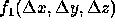 or
or
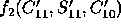 . Thus, eqs. (2) or (15)
can be rewritten as
. Thus, eqs. (2) or (15)
can be rewritten as

where T means the total value of the DSC residuum.
The combinations (3)-(14) contain if
there is a sum of DSCs, but they are offset-free if there is
a difference of the DSCs.
Check of SSCs by DSC combinations.
It follows from (3)-(14), by using (1) that
 ,
,
 ,
,

 ,
,
 ,
,
 ,
,
where the  are independently computed single
crossover residuals. [Similar relationships can also be
generated for the sums of AA, DD, DA, or AD, but they
suffer from the offset].
are independently computed single
crossover residuals. [Similar relationships can also be
generated for the sums of AA, DD, DA, or AD, but they
suffer from the offset].
We see that the combinations of the DSCs can be verified
independently by means of  or
or  or by their sum or
difference. Remarkable are those equations with
or by their sum or
difference. Remarkable are those equations with
 , as they should lead to numerically small values.
Thus, we have a diagnostic tool to investigate remaining
systematics in the altimetry data, e.g.,
(DD - DA) - = 0.
We also see immediately that
(AA - DA) + (DD-AD) = 0.
In practise, the combinations will not be exactly zero and
the non-zero value will be an error diagnostic.
[But note that the total 'noise' in these combinations summed over
the contributions from the individual AA, DA, DD, and AD residuals
may become so large that a unique interpretation
of systematic error may not be possible.]
, as they should lead to numerically small values.
Thus, we have a diagnostic tool to investigate remaining
systematics in the altimetry data, e.g.,
(DD - DA) - = 0.
We also see immediately that
(AA - DA) + (DD-AD) = 0.
In practise, the combinations will not be exactly zero and
the non-zero value will be an error diagnostic.
[But note that the total 'noise' in these combinations summed over
the contributions from the individual AA, DA, DD, and AD residuals
may become so large that a unique interpretation
of systematic error may not be possible.]
2. STATISTICAL TREATMENT
We found interesting types of the combinations of the DSCs, namely
the substituting and zero combinations
(Klokocnˇk and Wagner, 1999). The first type can be applied
to dual altimetry missions in high-low orbits (like Geosat and
T/P), and yields for example approximate representation of the dominant
'mean' part of the full radial perturbations of the lower orbit.
The second type yields no orbit error due to the static
geopotential and can help to elucidate oceanographic changes
between passes, among other media errors in the altimetry
corrections.
We call eqs. (3) - (14) basic diagnostics equations.
To use them for numerical computations and statistical
assessment of the crossover residuals, they need to be
slightly modified.
Let us consider for example eq. (13) with AA and DD already "offset free" (meaning that the relative coordinate system offset has already been removed from AA and from DD):

where 'a gravitational signal'  comes from the static geopotential (represented by a gravity
field model). In reality, eq. (18) will not be zero and
the value
comes from the static geopotential (represented by a gravity
field model). In reality, eq. (18) will not be zero and
the value

can be estimated statistically to see if the residual
is likely to contain a 'non-gravitational bias' (i.e.
a signal from other than the static geopotential;
for example, tidal error).
To turn eq. (18) into a "diagnostic" for
the 'non-gravitational bias' we assume
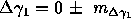 and
and
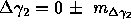 .
We estimate these expectations by projecting
the calibrated variance-covariance matrix
of the gravity model used for the orbit into
the indicated crossover quantities, yielding
their standard errors
.
We estimate these expectations by projecting
the calibrated variance-covariance matrix
of the gravity model used for the orbit into
the indicated crossover quantities, yielding
their standard errors  of the relevant components
 (for the formulae see Kloko‡nˇk et al,
1993). In our case, we make use of the JGM 3 covariances and the
software developed earlier for their projections to
the crossover errors (Kloko‡nˇk et al, ibid).
(for the formulae see Kloko‡nˇk et al,
1993). In our case, we make use of the JGM 3 covariances and the
software developed earlier for their projections to
the crossover errors (Kloko‡nˇk et al, ibid).
But what do we know about the validity of the JGM 3 covariance matrix?
Besides the extensive calibrations of it by its authors on ordinary
satellite data (Tapley et al, 1996) we have made our
own assessment (in terms of altimetric lumped latitude coefficients)
and conclude that for Geosat, ERS 1 and T/P,
the estimated errors of JGM 3 from its covariance matrix
are reasonable for the most part (Kloko‡nˇk et al, 1998, 1999).
Indeed our tests here are additional confirmations of this calibration in
terms of the geographic representation of the DSCs and SSCs.
So, for the purpose of the statistical treatment of (19) we use -
point by point (crossover by crossover) - the residual
value  corresponding to
  in this way

and its error estimate

where  are the formal standard deviations
of AA and DD (assuming no correlation between them) with
are the formal standard deviations
of AA and DD (assuming no correlation between them) with
 degrees of freedom of AA and DD, respectively,
and
are the standard errors projected from the JGM 3
covariances of the harmonic coeffcients (for the formulae see
Klokocnik et al, 1993).
degrees of freedom of AA and DD, respectively,
and
are the standard errors projected from the JGM 3
covariances of the harmonic coeffcients (for the formulae see
Klokocnik et al, 1993).
For the diagnostics given by eqs. (17), which are "potential zero's" not requiring a geopotential covariance projection from a gravity model, we have, by analogy to eqs (20) and (21), for example

and the error estimate

with  ,
,  , and
, and  degrees of freedom
of the DD, DA, and input residuals.
degrees of freedom
of the DD, DA, and input residuals.
The ratio

has the character of the Student-t distribution. For plotting figures we can use the ratio

where the values of the Student distribution  for
risk
for
risk  =1% are taken from a table (for this distribution)
and the degree of freedom
=1% are taken from a table (for this distribution)
and the degree of freedom
 from our data files of the DSC residuals.
The ratio
from our data files of the DSC residuals.
The ratio  means that we accept the null hypothesis
(i.e. that the measured is random with variance
means that we accept the null hypothesis
(i.e. that the measured is random with variance  ), while
 means that we reject the zero (random) hypothesis and suggest the
measured is anomalous.
For higher and higher n, the Student distribution is closer and closer
to the normal distribution (e.g., for n = 5, 30, 100, 300,
=1%, are 4.03, 2.75, 2.63, 2.59,
etc, respectively, in contrast to the normal distribution,
where the interval
means that we reject the zero (random) hypothesis and suggest the
measured is anomalous.
For higher and higher n, the Student distribution is closer and closer
to the normal distribution (e.g., for n = 5, 30, 100, 300,
=1%, are 4.03, 2.75, 2.63, 2.59,
etc, respectively, in contrast to the normal distribution,
where the interval  is constant, for the given risk;
here 2.50). For n lower than
is constant, for the given risk;
here 2.50). For n lower than  10,
we do not expect that the statistic is conclusive for our purpose.
10,
we do not expect that the statistic is conclusive for our purpose.
3. EXAMPLES
Due to space reasons we cannot present all the examples we have
available. For these the reader can contact the authors by e-mail and/or
to visit pub directory on
sunkl.asu.cas.cz and can GET by anonymous FTP
various (mostly) color plots
(the directory: /pub/jklokocn/GMTFIG/
and /pub/jklokocn/PAPERS/JG4_99/).
We used GMT (Wessel and Smith, 1995), version 3.0.
To avoid any misinterpretation of the following examples, we
emphasize:
(1) Case  : we are nearly sure (99%)
that the null hypothesis can be rejected, i.e. the DSC
combinations exhibit a systematic effect (not covered by errors
in the JGM 3 model and by "random" errors of the DSC data themselves).
: we are nearly sure (99%)
that the null hypothesis can be rejected, i.e. the DSC
combinations exhibit a systematic effect (not covered by errors
in the JGM 3 model and by "random" errors of the DSC data themselves).
(2) Case : a systematic effect
(probably due to a 'non-gravitational' error) may exist in the
tested DSC combination, but it is smaller than the error permitted in
the gravity model used plus crossover data noise.
3.1. Data and JGM 3 Covariance Projections
We use NOAA GDR files for Geosat, NASA/JPL GDRs for T/P and ESA ODRs for
ERS 1. The orbit basis for the altimetric heights for the Geosat and T/P
files is the JGM 3 geopotential (Tapley et al, 1996).
We used NOAA Geosat SSCs and DSCs from both GM and ERM mission. The basis
for ERS 1 heights is also JGM 3 for an early release (1996)
but the model DGM E04 (Scharroo and Visser, 1998) was used
for Pathfinder data in 1997 which we also employed in our comparisons.
(We converted the ERS 1 heights from DGM E04 to JGM 3 basis by applying
to them, according to pass sense, the geopotential-orbit effect from the
difference in the two models). The crossovers were computed at NOAA,
Silver Spring, from algorithms by one of the authors (CW) for Pathfinder
data, and Russ Agreen for data from the other sources.
The original altimeter heights for all three missions were first reduced
to sea surface heights using the reference orbits and a standard ellipsoid
and geoid for all three missions after correction for path delays and biases
from a number of media sources. These corrections include delays from
the ionosphere, the wet and dry troposphere, the sea state bias
and a variable ocean surface model which includes
the inverse barometer response to air pressure as well
as the ocean tides from the CSR3.0 model (including bottom load) and
the solid earth tides (see Table 2 in Kloko‡nˇk et al, 1999).
An important change in the sea state bias for T/P occured
between an earlier (1996) release and one employed in 1997
(Pathfinder). The significance of these discrepancies
will be noted below.
Figs. 1 and 2 show the DSC residuals (in [cm]),
the data input to our analysis,
for Geosat&T/P and for ERS1&T/P JGM 3-based,
respectively. All AD, DA, AA, and DD sets (except AD and DA for
Geosat&T/P) have been cleared of a relative coordinate
frame offset between Geosat or ERS 1 and T/P.
(There is insufficient data in the tropics to clear AD and DA
of this offset for Geosat&T/P).
Data shown on Figs. 1 and 2 are long-term averages,
in this case 1 year averaged month-to-month data.
The 3 year averaged data for Geosat&T/P look similarly and
has already been shown elsewhere (Kloko‡nˇk et al, 1998).
The term 'month-to-month' average over a x-year gap
between years  and
and  means
we average data from January of
satellite
means
we average data from January of
satellite  with data from January of
satellite
with data from January of
satellite  , Feb of with
Feb of , etc. We hope to avoid in this
way the seasonal fluctuations of both the ocean's surface
and media errors as much as possible.
, Feb of with
Feb of , etc. We hope to avoid in this
way the seasonal fluctuations of both the ocean's surface
and media errors as much as possible.
The projections of the calibrated variance-covariance
matrix of JGM 3 - the model used to compute the orbits
and all the crossovers - are shown for Geosat, T/P, and
ERS 1 respectively on Figs. 3 and 4; always only those parts
that we need to perform the Student statistics on the relevant
diagnostic equations. The formulae are taken from
(Kloko‡nˇk et al, 1993).
3.2. (AA-DD) and (AA+DD) combinations
Figs. 5a,b,c,d show AA-DD and AA+DD of Geosat&T/P from the
1 year averaged data and the Student statistics (23) on
the diagnostic equations (14) and (13). While for the difference (14),
Fig. 5c, there is no remaining systematic effect, for the sum (13),
on Fig. 5d, we see anomalous residual features mostly
along the main ocean currents.
Recall that there is an 8-year gap in the Geosat&T/P DSCs
and these effects seem to be unaveraged anomalies
for these active currents.
Note that the pair sum tends to keep any such
environmental anomalies while
the pair difference tends to cancel them. The reason is the difference
between ascending and descending times and locations in the bins for
each month is negligible compared to the gross environmental effect
over the multi-year gap.
The artefact west of Australia on Fig. 5d may be a small
geopotential-orbit anomaly above the 1-  level of JGM 3 harmonic coefficients, or due to problematic
tide modelling in these seas (Chao 1998, priv. commun.),
but also, considering the time span of the Geosat data
(April 1985 - March 1986), it could be
an un-averaged El Niño effect in the Indian ocean.
Another possible origin would
be meanders in the Leeuwin current which is flowing in
this area and is poorly known.
level of JGM 3 harmonic coefficients, or due to problematic
tide modelling in these seas (Chao 1998, priv. commun.),
but also, considering the time span of the Geosat data
(April 1985 - March 1986), it could be
an un-averaged El Niño effect in the Indian ocean.
Another possible origin would
be meanders in the Leeuwin current which is flowing in
this area and is poorly known.
To assess the role of averaging, we add Fig. 5e with the same
Student statistics for the AA+DD Geosat&T/P data, but from
3-year averages (month-to-month averages leading to minimization
of seasonal effects). Both populations (the 3 y and 1 y averages)
have similar statistical properties (distribution and formal standard
deviations). By comparing Fig. 5e to 5d, we still
see anomalous features in the north-west Pacific ocean and
along other main ocean currents, but to a lesser extent than from
the 1 y averages, much less anomaly west of Australia from
the 3 y averages, but more pronounced differences in a tropical
Pacific area (two 'hills'). Our explanation is that the longer
averaging helps to decrease the residuals due to the unmodelled
ocean currents; the mid-Pacific 'hills' are echos of El Niño,
by chance missing in the 1 year averages
(which were computed from Geosat-T/P data in the interval
1985Apr1993 to 1986Mar1994).
3.3. On the ocean currents removal
For geopotential analysis, a logical further step would be to model
the ocean currents, providing a new correction of altimetry data
due to them,
and to remove this source from the DSC residuals. Then, with new,
repeated tests with the combinations of the DSC and the relevant
Student statistics, we should see a surface as in Fig. 5d or 5e,
but without systematic effects.
Is long term ocean modelling currently up to this task?
Our conclusion is yes (with significant uncertainties) for
certain time periods, time differences and ocean areas, but
no
specifically for the 8 year gap in our Geosat&T/P DSCs or for the
zones of strong gyres and currents at mid to high latitudes.
We had available and analysed the behaviour of two
Ocean Circulation Models (OCM), POCM (Parallel Ocean Climate
Model, version 4B;
Stammer et al, 1996) and Carton's OCM (Carton, 1996). Both models are
generated from so-called primitive equations operating at many depth
levels using algorithms first developed more than 20 years ago at Princeton's
Geophysical Fluid Dynamics Laboratory. The essential differences
between them are that POCM is an eddy resolving model, important
for our anomalous data, but without external data assimilation,
while Carton's OCM does not have high resolution at mid to
high latitudes but does assimilate global (collinear) satellite
altimetry as well as heat data in the tropics. However, most
important for us, POCM 4B is only available from 1987 through 1996
while Carton's GCM only covers 1980 through 1995 and so both are not
available for our full Geosat-T/P DSCs (1985-1996).
Nevertheless the OCMs are promising and show rather good correlation
with sea height differences when averaged over extended spaces and times.
This is best illustrated in global comparisons with collinear T/P altimetry
taken over seasonal time spans (Figures 6 a,b,c). Here we show average
sea height differences of the models and T/P altimetry between the months of
September and March 1993, in 2x4 degree bins for T/P (latitude by
longitude), 1x1 for POCM 4B
and with variable bin sizes for Carton's OCM (2.5  in longitude
by 0.5 in latitude at the equator to 3 at latitude
in longitude
by 0.5 in latitude at the equator to 3 at latitude
 60 degrees). While the appearance of correlation between the models
and the altimetry is good, especially
in the northern hemisphere, the actual performance globally is only fair.
The correlation of the POCM 4B with the altimetry
is actually much more significant than for Carton's OCM even
though the overall value is somewhat less because many more POCM bins
are covered in the comparison. In addition, the POCM 4B
contains no altimeter data.
60 degrees). While the appearance of correlation between the models
and the altimetry is good, especially
in the northern hemisphere, the actual performance globally is only fair.
The correlation of the POCM 4B with the altimetry
is actually much more significant than for Carton's OCM even
though the overall value is somewhat less because many more POCM bins
are covered in the comparison. In addition, the POCM 4B
contains no altimeter data.
We have also tested these models against revolutions of T/P collinear
altimeter differences (point by point along track) across maximum season
contrasts (such as those above)
and find the correlation of model and altimetry to be positive but even less
so than for the global area monthly averages. Our conclusion is that except
for certain (quieter) areas the models do not have the accuracy necessary
for geodetic use.
3.4. Substituting and Levitating combinations
Figs. 7a,b,c,d show (for ERS 1&T/P) examples of substituting
combinations AD+AA and DD+DA and Figs. 8a,b,c,d of levitating
combinations AD-AA and DD-DA, with their relevant statistics.
In both cases we can see 'along-track' residual patterns
following the ascending or descending tracks
of ERS 1, but their origin on Figs. 7 and 8 must be different.
The anomalies in the sum "substitutions" can combine (add)
anomalous orbit-geopotential error in ERS 1
from JGM 3 with environmental (media correction) errors
from both altimeters while those in the minus "substitutions"
should be restricted only to media
or tidal correction errors in the T/P part of the pairs.
But the geopotential-orbit contribution for T/P is minor,
about 1 cm; see Figs. 3c,d.
We see that Figs. 8c,d exhibit strong systematic effects
- the levitating combinations, however, should be very small
(see eqs. 4 and 6); in turn, Figs. 8c,d indicate possible
residual errors in media or tidal corrections for T/P, in the
original NOAA GDR data (see below for more details at
Figs. 9 and 10).
3.5. Zero combinations, using DSC - SSC Residuals
Assume a 'high-low' altimetry satellite pair, like ERS&T/P or Geosat&T/P. It is probably expected by readers that the SSCs, DSCs and their combinations will be used to show some 'defects' or 'inaccuracy' for the lower orbiting satellite. On the contrary by focusing on the geopotentially quieter higher orbit we may more easily detect smaller non-geopotential biases. We recall eqs. (1), (4), (6) or (17). From these it follows that

But recall also that belongs in this case to T/P.
Therefore, by using the levitating combinations, we can
'filter-out' the effect on the lower satellite and test
the higher flying satellite. For example, we can
compare DSC from Geosat&T/P or ERS&T/P to SSC of T/P,
determined independently. We have several such examples
for NOAA and GFZ data, revealing a remarkable difference:
a systematic trend of SSC T/P from the NOAA data and only
a noise in T/P SSCs from GFZ crossover reduction (for more
details see Kloko‡nˇk et al, 1998). Here we present another
example, Fig 9 a,b,c, where we even use DSCs based on
two different gravity models!
Fig. 9 a,b show the levitating combinations (DD-DA) and (AD-AA)
of ERS1 & T/P (both surrogates for T/P SSCs),
where the orbit of ERS 1 is based on the DGM E04
model, tailored to ERS1 & 2 orbits (by their SSCs),
see Scharroo and Visser (1998), but the T/P passes are JGM 3-based.
Fig. 9c then shows the SSCs of T/P, JGM 3-based.
Note that while the SDs of the combinations must be expected to be higher
than the SDs of the SSCs (1.7 cm vs 1.0 cm in this case),
the values of the combinations themselves are larger
than their SDs and indeed diagnose a 'non-gravitational' bias.
The agreement between Figs. 9a and 9b is very good;
the same is true for Figs. 9a&b vs Fig. 9c
(i.e. DSCs combinations vs SSC of T/P),
although the DSCs are 'internally inconsistent' i.e.
related to two different gravity field models.
According to the theory, we deal with the zero combinations
and thus, that 'inconsistency' is cancelled exactly.
[In reality, the cancelation can never be exact because
the location of the crossovers in the bins differ slightly between
the various types].
We have in fact SSCs of T/P derived twice:
(i) once from the levitating (surrogate) combinations,
based on the DSCs (Figs. 9a,b);
these are the 'surrogates' of T/P SSC, according to
eqs. 4, 6, and 17;
(ii) once from the actual SSC data of T/P (Fig. 9c),
independent of the DSC combinations.
Consider also Fig. 10, where 10a shows the NOAA (AD-AA) DSC
combination, and Fig. 10b the Pathfinder (AD-AA) DSC
combination. These 'surrogates' of T/P SSCs are compared
to the actual SSC of T/P, now on Fig. 10c, using the SSC
from the NOAA data, and on Fig. 10d, from the Pathfinder data,
(all JGM 3-based).
The two direct sources of T/P SSC are obviously showing nearly
the same result and this result agrees with the Pathfinder
surrogate, not the NOAA. The NOAA DSCs must to be blame and
since the surrogates isolate the signal from T/P part (the ERS 1
part cancelling), this proves it is the T/P of the NOAA DSCs that
are the cause of the problem. Note also that the Student
statistics applied to the surrogate combinations (AD-AA) or
(DA-DD) with the NOAA data confirms systematics effects
(see Figs. 8c,d) while with the Pathfinder data, there are
no such systematic errors (not shown here).
In summary (to subsection 3.4. and 3.5), we confirm our
previous suspicion (from Fig. 8)
that there is a problem in the older NOAA data for T/P.
Indeed, it is known that the 'media model' for T/P at NOAA was
changed after 1996 (principally the electromagnetic bias) and improved
(Kuhn, 1998, private commun.).
This example is not presented here to criticize NOAA for their
process of correcting altimetry data, but to show the
possibility of our method detecting discrepancies in residual altimetry
signals even for T/P.
4. CONCLUSION
Combinations of the single and dual-satellite crossovers
(SSC and DSC) in altimetry have been found useful for error analysis
in conjuction with their application to geodesy and oceanography.
One kind of the combinations, when applied to dual missions in
high-low orbits, approximates the dominant 'mean' part or the total
radial perturbations of the lower orbit.
Another kind yields no geopotential error and
can help elucidate oceanographic changes between passes,
among other errors of altimetry corrections.
A third kind is a surrogate of SSC data and can be used
to check the significance of the background (non-geopotential) errors that
are not common to the two kinds of crossovers. We demonstrate, with this
last kind, a significant inconsistency in the media
corrections recommended for T/P (NOAA data) prior to 1997
with those after.
We have found that certain crossover combinations show the residual
unmodelled effect of the ocean currents over long time periods.
Our attempt to employ existing Ocean Current Models for
additional correction of altimetry data have not proved successful
because the models do not yet cover
adequately the time spans and ocean areas involved.
Acknowledments We are grateful to Prof. Francois Barlier for his care with our manuscript and two anonymous reviewers for their comments. We thank John Lillibridge and John Kuhn for the generation of NOAA's Geophysical Data Records and many useful consultations about their contents, Brian Beckley for essential and continuing help with interpreting the Pathfinder data, Laury Miller for providing access to the Carton's OCM, and Tom Johnson for kindly supplying his extensive bin averages of the POCM 4B surface heights. The support by grant A 3003703 from the Grant Agency of the Academy of Sciences of the Czech Republic (for JK &JK) is gratefully acknowledged. This research has been performed in the frame of Key project K 1003601 and project No. 7 of the Faculty of Civil Eng., Czech. Techn. Univ., Prague. We also thank Walter Smith and Paul Wessel for the GMT 3.0 version (Generic Mapping Tools) and consultations.
References
Bosch W, Klokocnik J, Wagner CA, Kostelecky J (1998)
Geosat and ERS -1 Datum Offsets Relative to TOPEX/Poseidon
and Geopotential Corrections Estimated Simultaneously from
Dual-satellite Crossover Altimetry, presented at
IAG Sect. II Symp. "Towards an Integrated Global
Geodetic Observing System", Munich, Germany.
Carton, J (1996)
Analysis of Global Ocean Assimilation,
www.meto.umd.edu/~carton/index.html.
Engelis T (1987)
Radial Orbit Error Reduction and Sea Surface Topography
Determination using Satellite Altimetry,
Dept. Geodet. Science and Surveying, Ohio State Univ.
Rep. No. 377, Columbus.
Klokocnik J, Kostelecky J, Jandova M (1993)
Altimetry with Dual-Satellite Crossovers,
presented at IAG GM Beijing, China, Session D 10:
"Impact of Satellite Altimetry on Gravity Field
Determination",
see also (1995): Manuscr. Geod., 20, 82.
Klokocnik J, Wagner CA, Kostelecky J (1996)
Accuracy Assessment of Recent Earth Gravity Models
using Crossover Altimetry,
Studia Geophys. et Geod., 40, 77.
Klokocnik J, Wagner CA, Kostelecky J, Rentsch M (1998)
Residual Errors in Dual-Satellite Crossover Altimetry Data:
An Independent Check, presented at EGS GA, Symp.:
Ocean Modelling from Altimetry and Remote Sensing,
Nice, France.
Klokocnik J, Wagner CA, Kostelecky J (1999)
Spectral Accuracy of JGM 3 from Satellite Crossover
Altimetry, J. Geod., 73, 138.
Klokocnik J, Wagner CA (1999) Combinations of Satellite
Crossovers to Study Orbit and Residual errors in Altimetry,
Celest. Mechanics, in print.
Naeije MC, Scharroo R, Wakker KF (1996) Monitoring of Ocean
Current Variations, NUSP Rep. 96-08, Delft Univ. Techn.,
Delft Inst. for Earth Oriented Space Research.
Rosborough GW (1986) Satellite Orbit Perturbations
due to the Geopotential, CSR-86-1 Univ. of Texas at
Austin, Center for Space Research.
Rosborough G W, Tapley B D (1987) Radial, Transverse
and Normal Satellite Position Perturbations due to
Geopotential, Celest. Mech. 40, 409.
Scharroo R, Visser P (1998) Precise Orbit Determination
and Gravity Field Improvement for the ERS Satellites,
J. Geophys. Res. 103, C4, 8113.
Shum CK, Zhang BH, Schutz BE, Tapley BD (1990)
Altimeter Crossover Methods for Precison Orbit
Determination, J. Astronaut. Sci., 38, 355.
Stammer D, Tokmakian R, Semtner A, Wunsch C (1996)
How well does a 1/4 Global Circulation Model Simulate
Large-scale Oceanic observations?,
J. Geophys. Res. 101, C10, 25,779.
Shum CK, Zhang BH, Schutz BE, Tapley BD (1990)
Altimeter Crossover Methods for Precison Orbit
Determination, J. Astronaut. Sci., 38, 355.
Tapley BD, and 14 others: (1996) The Joint Gravity
Model 3, J. Geophys. Res. 101, B12, 28029.
Wagner CA, Cheney RE (1992) Global Sea Level Change
from Satellite Altimetry, J. Geophys. Res. 97,
C10, 15607.
Wagner CA, Klokocnik J, Cheney RE, (1997a)
Making the Connection between Geosat and TOPEX/Poseidon,
J. Geod., 71, 273.
Wagner CA, Klokocnik J, Kostelecky J, (1997b)
Dual-Satellite Crossover Latitude-Lumped Coefficients,
their use in Geodesy and Oceanography,
J. Geod., 71, 603.
Wessel P, Smith WHF (1995) New Version of the Generic Mapping Tools Released, EOS, Trans. AGU, 76, 329.
Figures
Fig. 1. Dual-satellite crossover residuals AA, DD, AD, and DA
between Geosat and T/P, JGM 3 - based, in 2x3 deg bins.
NOAA 1 year averages.
Color scale in centimeters.
The residuals "before O.R." (offset removal) and "after O.R."
should be distinguished.
Fig. 2. Dual-satellite crossover residuals AA, DD, AD, and DA,
all after the coordinate offset removal, between ERS 1 and T/P,
JGM 3 - based, in 2x3 deg bins. NOAA 1 year averages.
Color scale in centimeters.
Fig. 3. Geosat and T/P: the variable (a,c) and
geographically correlated (mean) part (b,d) of the radial orbit
error, as projected from the calibrated variance-covariance matrix
of the harmonic geopotential coefficients of JGM 3 (to 50x50),
using 4 day or 10 day cut of orbit perturbations, with
10x10 deg grid in latitude and longitude. Notice two different
scales (both in centimeters).
Fig. 4. ERS 1: the radial orbit error (a,b), its variable
(c) and mean (d) parts, as projected from the calibrated
variance-covariance matrix of the harmonic geopotential
coefficients of JGM 3 (to 50x50), using a 4 day cut of orbit
perturbations, with 10x10 deg grid in lat/long.
Notice two different scales (centimeters).
Fig. 5. Combinations AA-DD [offset-free by definition]
and (AA+DD)/2 [offset-free] of the DSC of
Geosat&T/P, JGM 3 - based (a, b), 1 year NOAA averages,
with their relevant Student statistics (c, d).
The scale (for Figs a, b) is in centimeters,
and dimensionless for the statistics
(see eq. 23). Clearly visible are systematic effects
(the ratio  above 1.0) on Fig. 5d (1 year averages)
and on Fig. 5e (3 year averages).
above 1.0) on Fig. 5d (1 year averages)
and on Fig. 5e (3 year averages).
Fig. 6. The change in sea level between March and September
1993. Test of Ocean Circulation models:
a comparison of seasonal global circulation models
with the T/P collinear differences (POCM run 4B and Carton's
GCM), in 1x1 deg bin in lat/long. For more details see text.
Fig. 7 Substituting combinations AA+AD and DD+DA of
the DSCs of ERS 1&T/P, JGM 3- based (a, b), with their
relevant Student statistics (c, d).
The scale for Figs a, b is in centimeters,
dimensionless for the statistics
(see eq. 23). Notice systematic 'along-track' effects
(statistics above 1.0) on Figs. 7 c, d.
[White spots = no data].
For more details see text.
Fig. 8. Zero (levitating) combinations (AD-AA)/2 and
(DD-DA)/2, eqs. 4 and -6, of the DSCs of ERS 1&T/P,
JGM 3- based (a, b), 1 year NOAA averages,
with their relevant Student statistics (c, d).
Notice systematic effects (statistics above 1.0)
on Figs. 8c, d, mainly in central Pacific.
For more details see text.
Fig. 9. The levitating combinations (DD-DA) and (AD-AA) of
ERS 1 and T/P, where the crossovers for ERS 1 are based on
DGM E04 gravity model (Delft) and the crossovers for T/P on
JGM 3 (NOAA)! These combinations (Figs. 9 a,b)
provide a T/P 'surrogate', according to eq. 17.
They are compared to the T/P 'original' single-satellite
crossovers (JGM 3 - based), Fig. 9c.
A good agreement between Figs. 9a,b and Fig. 9c
supports hypothesis that the NOAA
data of T/P suffers from an inconsistency probably in
media corrections recommended for T/P prior to 1997,
in contrast with those used later.
Fig. 10. (a) shows the NOAA (AD-AA) DSC combination,
(b) the Pathfinder (AD-AA) DSC combination.
These 'surrogates' of T/P are compared to real SSC T/P,
(c) from the NOAA GDCs, (d) from Pathfinder altimetry.
It again suggests that the NOAA T/P
corrections prior to 1997 are inconsistent
with those used later.